Food, Glorious Food!
 |
| My photo taken at Avebury Manor |
From farming, we are invited to look more closely at food.
There were ‘flesh’ and ‘fish’ days in Medieval England.
Basically, on every Wednesday, Friday and Saturday, fish and not flesh would be eaten (by the wealthy, of course – the peasants would mostly eat bread, cheese and vegetables). Meat free Monday? Nope, but there were three whole other days. But this was for religious not vegetarian reasons. Although, certain friars did only ever eat fish.
In a later post on religion, I’ll look at the hard
fast/Ember Days too.

There are mixed theories on meal times. Certainly, in the
earlier medieval period, most people seemed to have just two meals a day. But
by the Late Middle Ages, three meals were consumed. This is how I understand it
to be – others say different. And of course, this is a rich person’s approach.
Typically, those lucky enough to dwell in manor houses would rise with the sun. Yes, actual dawn! Following morning Mass, they would have a modest breakfast of (white) bread and wine or ale. Start the day off right, eh? Phew, what happened to, “It’s a bit early for me?” Well, the water would most likely kill you if you drank that, so alcohol it was!
Only around 8 householders would eat together for morning
meal. The kitchen staff and food servers
would grab what they could from the pantry ‘on the go’.

Lunch – only came in during the Late Middle Ages.
Lunch was confusingly referred to as dinner back then.
A light serving of meat/fish, bread and soup/pottage would
be served with yes, more ale or wine. The pottage the upper classes ate was
obviously better quality than the peasants’ version – more herbs/spices/meat
were added.

Dinner (called supper at the time) was apparently the lavish meal. All sorts of people would be in attendance; the bailiff, officials, farm workers, tenant farmers etc. Details of what was eaten listed below.
Brightly coloured food was fashionable – red, yellow and blue would often adorn the table! On May Day, all food was coloured green.
However, it occurs to me, that especially when entertaining other nobles, one would consider the distances travelled. Roads were unsafe, especially in the dark. So, mayhap, their main "dinner" meal would've been at what we now call lunch (midday/noon).
Grace would be said before every meal by the chaplain. Religion was ever
present.
Meals were communal affairs. All the household would eat together. Towards the end of the medieval period, nobles began to dine alone in privacy but were considered snooty for so doing. After all, there was an interdependence between all people, and that was to be honoured.

So, what did they eat? Well, perhaps better than we thought.
The average daily helping (including the inedible bits) was
around 1lb per person. The rich ate mainly meat, declaring vegetables poor
man’s food.
Meat

Beef and pork were eaten all year except during Lent.
The high status folks also had veal and capon (castrated
cockerel) most of the year. They would also eat swans, particularly at
Christmas. Heron and peacocks were also seen on tables. Smaller birds, such as lark and plover were on the menu too.
All summer – lamb and mutton were available
Pigeons were only eaten in summer
November – the Martinmas kill would occur, so some beef was
eaten, with the rest of it being salted and preserved to sustain them through winter
December to July – suckling pig
December to August – veal was on the menu
Chicken, pheasant, partridge, duck and goose were commonly
eaten.
Rabbits are slightly controversial as there is contradictory
evidence when they were introduced, and they struggled to breed at first
(ironic, eh?). But we do know coney was on the menu – these were bunnies bred
for the table.
And don’t forget venison – sorry, Bambi! Deer parks were
kept for the lords to go hunting – sport and food purposes.
Fish

Fish was surprisingly plentiful, even in towns. Although, if there were three fish days every week, plus the whole Lent period, maybe it's not so very surprising.
One could purchase herrings in bulk. Smoked red herrings
were cheaper than their pickled white cousins.
When herrings were scarce, barrels of salmon and sturgeon
could be bought.
Salt fish and stockfish were a constant dinner option.
If one lived near the coast, the following would be
available:
~ brill, butts (stop sniggering; this was a flat fish), cod,
crabs, crayfish, flathe, garfish, haddock, mackerel, merling, mussels, oysters,
plaice, sea-pike, shrimp, skate, sole, sparling, turbot and whelks
- And yet, try to buy those in your fish section or fish & chip shop these days! We really should eat more types of fish.
Special note on oysters – they were plentiful and cheap but
the cost went up ½ d. at Christmas as the demand was so high. Also, “never eat
an oyster unless there’s an R in the month” is a thing – they’re dangerously
poisonous May-Aug.
If one had a miller with a stew pond, eels could be farmed
there.
Cheese

Mmm...cheese! Yes, they did have the stuff. I'm just going to list the types available along with the approx. time they took to make.
{
Beaufort (French, firm elastic, aging
6-14months); Brie (3-6 weeks)
{
Camembert (3-5 weeks)
{
Cheddar (first recorded use is in 1500)(2months
to 2years age) – but first called Cheddar 1655
{ Comté
{
Cottage
{
Emmenthal (6-14months)
{
Farmer’s
{
Gloucester (first recorded use is in 1697)
{ Grana (first recorded use is in 1200)
{ Gorgonzola (first recorded use is in 879)
{
Gouda (first recorded use is in 1697)(3 month
aging)
{ Gruyére (7weeks to 3months age)
{ Maroilles
{ Mozzarella (30days)
{ Parmesan (first recorded use is in 1579)(10-24months)
{ Port-Salut
{ Reblochon
{ Rewen/Rowen/Ruayn (Autumn cheese, made after the cattle had fed on the second growth. This was apparently a semi-soft cheese, but not as soft as a ripe modern Brie: one period recipe says to grate it. It appears to be the same cheese that in France today is called fromage de gaing or Tart de Bry
{ Ricotta
{ Romano (5-12months)
{ Roquefort (first recorded use is in 1070)(2-4months)
{ Spermyse (soft or cream cheese flavored with herbs)
{ Stilton

Fruit was made into preserves (jam) and baked into pies. In lieu of sugar, they were great as sweeteners. Apples, pears and plums were perhaps most commonly found.
Dessert

As if all that wasn't enough, there was a dessert course. Because, we all know there's 'dessert tummy' space, even when full.
Cakes weren't really a thing. There were a few, such as honey cakes. But as there wasn't any self-raising flour, they leaned towards the bready end of the spectrum.
Pastry was huge though. I make mention in my book of apple and blackberry pie; totally a thing. And one of my own favourites (not that you'd tell from the way it's written in Love in the Roses)! 😜
Other dishes included plums sweetened in rosewater or pears stewed in honey and wine. Cream custard tarts were available. Cold custards and milky desserts were on offer.
Rose pudding was made by blanching white rose petals and mixing with warm milk and cornflour, cinnamon, sugar, ginger, chopped dates and pine nuts - and cooled.
Bread, Wine and Ale

The poor ate brown bread whilst the rich ate white. Really,
the serfs should have been far healthier than their lords if solely their diet
was considered. Obviously and sadly, not the case though.
Bread and ale were usually home made/brewed and were
available to all.
The rich drank wine – often red being more popular as white went
off faster.
Annual purchases of wine could be:
3 ½ pipes (1 pipe = 105 imperial gallons) of red wine
2 hogsheads (1 hogshead = approx. 52 imperial gallons) of
white wine
Beer and ale were drunk by all classes.
Posset Ale - was warmed milk mixed with ale (or wine), and was often spiced. The addition of egg yolks seems to have been optional. But it appears to have been a forerunner of eggnog.
It was enjoyed as a sleep aid and to cure colds and indigestion. It was even considered an aphrodisiac. It does sound very comforting.
Mulled wine - hot, spiced wine - very tasty stuff!
I'd also like to mention wassail. Heated cider, laced with spices such as cloves, cinnamon and ginger. Traditionally drunk as part of Christmas festivities.
To go wassailing is to gather in the orchards, sprinkling this hot cider around the trees to protect them from evil spirits. It became a thing for Twelfth Night (the end of Christmastide). This evolved into a practice where people would go door-to-door, singing in return for a cup of wassail. This could get drunkenly violent!
 |
| A (not medieval) recipe I found |
Pottage

I did feel pottage deserved its own heading. It was eaten by rich and poor alike. Although, the richer you were, the better the ingredients.
In essence, it was a soup or stew made of grains and vegetables.
Peasant homes would have a large pot over the fire, into which any scraps would go. Cabbage and bread were often added in. Mmm...their homes must've smelled ^lovely^!?
Whoever you were, it was a staple part of your diet.
Sugar, Honey & Salt

LOL, that was almost Sugar Honey Ice Tea 😉
So, from around 1154, sugar was being imported and was increasingly popular and cheaper. By the end of the 14th century, one could even purchase refined sugar. It was considerably more expensive than honey though, so really only available to the middle class and up.
Honey was widely available. Not only was it a sweetener, but was also used in medicine and a preservative. And was a key ingredient of mead (honey wine); an alcoholic beverage. However, mead was falling out of favour, as wine, ale and beer took precedence.
Salt was also a valuable commodity. As I live in Hampshire, I'd like to note that it was commonly harvested from the saltmarshes in Bitterne Manor, along the banks of the River Itchen in my county (amongst a few other places) 😊
It was used for curing/preserving meat and fish.
As a condiment, salt was only at the top table. Ergo, people sat "above the salt".
Herbs & Spices

Herbs were grown freely in the kitchen garden and were used for so many things. They flavoured food, were fab as anti-smell aids, cosmetics and medicine.
There was an abundance of herbs, but some of the most popular were:
{
betony
{
chamomile
{
comfrey
{
dill
{
hyssop
{
lavender
{
lemon balm
{
lovage
{
meadowsweet
{ mint
{
rosemary
{
rue
{
sage
{
woad
{ vervain
{ yarrow
The most common (yet expensive) spices were:
{
caraway
{
cardamom
{
cinnamon
{
cloves
{
coriander
{
cumin
{
garlic
{
ginger
{
mace
{ mustard
{
nutmeg
{
pepper
{ saffron
{ turmeric
Spices were particularly used in the cooking of meat. Honestly, I was surprised how widely they were used. I bought a medieval cookery book, and saffron repeatedly cropped up.
So, far from being bland, medieval cookery was strewn with yummy flavours.
What they did not have, to my chagrin, was: potatoes, tomatoes, (*sobs*) coffee or even tea. I mean, how can anyone live without coffee OR potatoes? Heathens! 😆
Banquets & Feasts
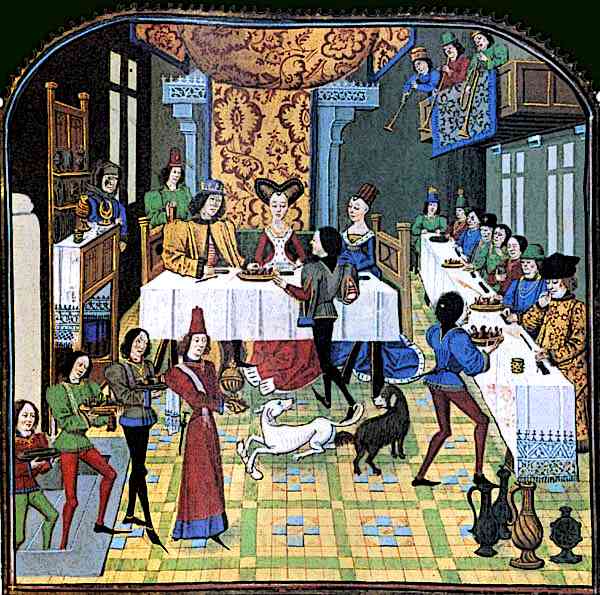
Cutlery & Manners

Please rid your mind of kings gnawing on chicken legs. Grotesque!
Table manners were important.
So, in previous posts, I've mentioned the laver outside the Great Hall, used for washing hands before and after meals. And there were finger bowls shared between two people on the table.
Every person would have their own knife, attached to their belt. No forks, remember! People were expected to elegantly slice meat with their knife and take it to their mouth with their fingers. Chewing with their mouth closed (much to the relief of this misophonia sufferer!).
Spoons were used for soups and stews - hello pottage! And frumenty - which could be served hot or cold, either first or last course. This was a thick grain (cracked wheat) porridge made with warm milk. Fruit and or meat, along with spices could be added. Again, rich and poor ate this.
Bowls were often made of wood. Trenchers did exist; the flat, stale bread, hollowed out to serve stews and soups. It is now generally believed this bread was inedible. And I'm dubious as to how common they were, in reality. Grain was precious.
Napkins in medieval England were pieces of cloth. If one was of higher rank, this would be draped over one's left shoulder. Lower ranks, over their arm.
If someone of higher rank entered or left the room, the lower orders would stand.------------------------------------------------------------------------------------
My book, Love in the Roses is
available for pre-order (click here).

To protect her family, she must marry the enemy!
The fictitious tale of a knight’s
daughter, living life as it very well may have been in 1484.
------------------------------------------------------------------------------------


